
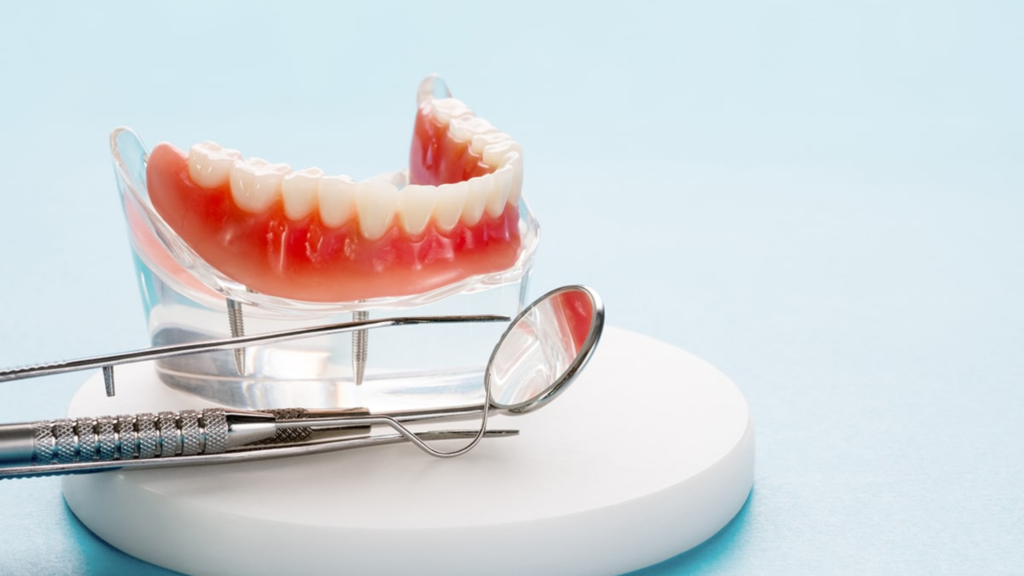
If you’ve lost most or all of your teeth in one arch – or you’re facing that future because of failing teeth – there are really only two practical paths forward. Traditional dentures have existed in some form for thousands of years. Or All-on-4 dental implants, which use four titanium posts to permanently anchor a full-arch bridge to your jaw.
They are not the same product. They don’t deliver the same experience. And they don’t carry the same price tag.
This guide is an honest side-by-side comparison from a fellowship-trained implant specialist – Dr. Rushabh Doshi at SmileOn Dental Implants – who has placed 3,000+ implants and seen patients choose both paths. The goal isn’t to talk you into All-on-4. It’s to give you the information to decide whether the upgrade is worth it for your situation.
The 60-Second Comparison
| Traditional Dentures | All-on-4 | |
|---|---|---|
| Cost per arch (2026) | $1,500* – $3,500* | $24,000* |
| Time to receive | 4–8 weeks | Same day (with extractions if needed) |
| Removable? | Yes (daily) | No (fixed) |
| Adhesive needed? | Often, yes | No |
| Eat steak, apples, and corn on the cob? | Difficult / not advised | Yes |
| Bone preservation | No – accelerates bone loss | Yes – implants stimulate bone |
| Lifespan | 5–10 years (relines every 1–2) | 20+ years (bridge may be refreshed) |
| Maintenance | Soak nightly, daily cleaning, adhesive | Brush + floss like real teeth |
| Speech impact | Common, especially initially | Minimal |
| Surgery required? | No | Yes (single-day procedure) |
| Insurance coverage | Often partial | Rarely covered |
| Monthly financing | N/A typically | From $299/mo |
That’s the cheat sheet. Below is everything those rows leave out.
What Traditional Dentures Actually Are
A traditional denture is a removable acrylic prosthetic that fits over your gums. The upper denture relies on a suction seal against the roof of your mouth. The lower denture sits on the ridge of your jaw and is held by gravity, jaw shape, and (frequently) adhesive paste.
There are two types worth knowing:
Conventional dentures are made after any remaining teeth have been removed and the gums have healed, usually 8–12 weeks post-extraction. The upside is a better-fitting final product. The downside is months without teeth while you wait, or wearing a temporary “healing denture.”
Immediate dentures are made before your teeth are extracted and placed the same day as the extractions. You walk out with teeth. The downside is the fit will change significantly as your gums and jawbone heal and shrink over the following 6–12 months, requiring multiple relines and often a remake.
Either way, what you end up with is a piece of acrylic that sits on top of your gums and is removed for cleaning every day. Our restorative dentistry team can walk you through which denture option makes sense for your situation.
What All-on-4 Actually Is
All-on-4 implants are a full-arch restoration anchored by four titanium implants surgically placed into the jawbone. The two posterior implants are angled (usually 30–45°) to engage the densest available bone and avoid critical anatomical structures like the sinus and the inferior alveolar nerve.
A custom-milled bridge – most commonly zirconia for permanence, sometimes acrylic-over-titanium for cost – is fixed to those four implants. It does not come out. You brush and floss it like real teeth.
The procedure is typically completed in a single surgical day. Extractions of any remaining failing teeth, implant placement, and attachment of a temporary fixed bridge all happen in one visit. The final zirconia bridge is placed 3–6 months later, after the implants have fully integrated with the bone. To learn more about the full range of implant options we offer, visit our implant and prosthetic dentistry.
Cost: Where the Gap Actually Comes From
The honest cost comparison in DFW for 2026:
Traditional dentures, per arch: $1,500* – $3,500* for standard quality. Premium dentures can run $4,000*–$6,000*.
All-on-4, per arch: $24,000 at SmileOn for the permanent zirconia restoration. Includes the surgical placement of four implants, the abutments, the temporary bridge worn during healing, and the final zirconia bridge.
That’s roughly an 8–10× cost gap on the surface. But it’s a misleading number on its own, for three reasons.
First, denture costs compound. A traditional denture needs to be relined every 1–2 years (~$300–$500 each time) and replaced every 5–10 years. Over 20 years, that’s typically $4,000–$8,000 in maintenance and replacements on top of the initial price.
Second, denture costs include things people don’t budget for. Adhesive paste runs roughly $5–$15/month, call it $1,500–$4,000 over 20 years. Denture cleaning tablets, special brushes, soaking solutions, and another $500–$1,500.
Third, the bone-loss cost shows up later. Because dentures don’t stimulate the jawbone, the underlying bone shrinks an average of 25% in the first year after tooth loss and continues for life. Within 10–15 years, the changed facial shape often requires a denture remake or, if someone decides to switch to implants later, expensive bone grafting before implants become possible. That’s a $3,000–$15,000 problem that doesn’t appear on the original denture invoice.
When you stack those out, the 20-year comparison looks more like:
- Traditional dentures, 20-year total: $9,000–$18,000 (initial + relines + replacements + adhesives + potential bone grafting)
- All-on-4, 20-year total: $24,000–$28,000 (initial + occasional bridge refresh + routine hygiene)
Still more expensive, but not 8× more expensive. About 1.5–3× more, with a dramatically different experience. We offer flexible financing options through CareCredit, Cherry, Sunbit, and LendingClub to make the investment more manageable, and we work with most major insurance providers to maximize whatever coverage you have. Patients visiting our 360 Dental Lounge in Mansfield and Irving Family Dental in Irving can also explore financing options at those locations.
Eating: The Difference Most Patients Underestimate
This is the single biggest quality-of-life difference between the two options. Patients who have worn traditional dentures and then switched to All-on-4 describe it more often as “I forgot what real eating felt like” than as any other comparison.
With traditional dentures:
- Steak, ribs, crusty bread, raw apples, and corn on the cob are generally off the menu or cut into small pieces
- Chewing efficiency drops to roughly 20% of natural teeth
- Tougher foods can dislodge the denture, especially the lower one
- Adhesive helps, but doesn’t restore full bite strength
- Patients often shift their diet toward softer foods, which, over time, affects nutrition
With All-on-4:
- Bite force is restored to roughly 70–90% of natural teeth
- Steak, apples, and corn are back on the menu
- No worry about dislodgement during meals
- Diet variety returns
For some patients, this difference is the entire reason they choose All-on-4. For others, especially those who’ve already adjusted to a softer diet long-term, it’s less of a driving factor.
Bone Preservation: The Silent Argument for Implants
Here’s what most denture wearers don’t get told clearly: when you lose teeth, your jawbone starts to resorb (shrink). The bone needs the stimulation of tooth roots to maintain its volume. Without it, the body interprets the bone as no longer needed and reabsorbs the calcium for other uses.
Traditional dentures sit on top of the gums; they don’t stimulate the bone underneath. So bone loss continues, year after year. This is what causes the “collapsed” facial appearance often associated with long-term denture wear: shortened lower face, sunken cheeks, pronounced chin.
Dental implants act like artificial tooth roots. They transmit chewing forces into the jawbone, which maintains the bone’s structure. The facial shape is preserved. The jaw stays strong. This is the single most important medical difference between the two options.
If you are in your 40s or 50s when you lose your teeth, this matters significantly. If you are in your 80s and primarily concerned with the next 5–10 years, it matters less.
Speech and Confidence
Most denture wearers adapt to the speech changes within a few weeks, but most also report that certain sounds (especially “s” and “th”) never feel quite the same. The roof-covering plate of an upper denture can also affect taste perception slightly because of the reduced palate exposure.
All-on-4 doesn’t cover the roof of the mouth and doesn’t slip. Speech is generally indistinguishable from natural teeth after a brief adjustment period.
For patients in client-facing professions, public-speaking roles, or who simply value the social confidence of “I never have to think about my teeth,” this difference matters. For patients who don’t speak professionally, it’s a smaller factor. Browse our smile gallery to see real patient results and the confidence transformations that follow.
Maintenance: Daily Reality
Traditional dentures require a daily routine: removal for sleep, overnight soaking in a cleaning solution, brushing the denture itself, brushing the gums and tongue, and reapplying adhesive each morning. Most patients adapt, but it is a daily ritual.
All-on-4 is brushed and flossed like natural teeth, with the addition of a water flosser (Waterpik) for cleaning under the bridge. There’s no removal, no soaking, no adhesive. The maintenance is closer to natural-tooth care than denture care.
Both options require professional cleanings every 6 months. Both can develop complications if neglected: gum disease for dentures, peri-implantitis for All-on-4, though both are largely preventable with consistent hygiene. Our preventive dentistry team provides the routine care that keeps both options performing at their best long-term, and patients near Mansfield can count on the same standard of care at 360 Dental Lounge.
Lifespan Honestly Compared
A well-made traditional denture lasts 5–10 years before it needs replacement. The fit will shift before then because of the ongoing bone loss, requiring relines every 1–2 years on average.
A well-placed All-on-4 has different lifespans for its two components. The four implants themselves, when successful, last 20+ years and often a lifetime. The bridge attached to the zirconia typically lasts 15–25 years, occasionally longer. If the bridge wears or breaks, it can usually be replaced without replacing the implants underneath.
Long-term, All-on-4 is the more durable option by a wide margin.
Who Should Choose Traditional Dentures
There are real situations where traditional dentures are the right choice:
- The budget constraint is absolute. If $1,500–$3,500 stretches the available budget, financing All-on-4 may not be feasible.
- Medical conditions prevent surgery. Uncontrolled diabetes, certain cancer treatments, severe osteoporosis treated with IV bisphosphonates, or patients who can’t undergo a 2–to 4-hour surgical procedure may not be candidates for implants.
- Severe untreated gum disease. Active periodontal disease must be resolved before any implant work. In some cases, this isn’t practically achievable.
- Insufficient bone with no graft option. Some patients have lost too much bone for All-on-4 to be possible, even with zygomatic alternatives.
- Older age plus shorter health horizon. A patient in their late 80s with a 5–10 year health horizon may reasonably prefer the lower upfront cost and avoid surgery.
- Strong personal preference for removable. Some patients genuinely prefer being able to take their teeth out at night.
These are honest reasons. If any of them apply, traditional dentures are a perfectly reasonable choice. Our team at Arlington Dental Lounge is here to help you explore whichever path fits your needs, as are our teams at 360 Dental Lounge in Mansfield and Irving Family Dental in Irving.
Who Should Choose All-on-4
All-on-4 is generally the stronger choice for patients who:
- Have a long horizon ahead (under 70 is common; 70s and even 80s can be excellent candidates with good health)
- Want to eat normally without restriction
- Want to preserve facial structure and avoid the long-term collapsed appearance
- Have an active social or professional life where teeth confidence matters
- Have adequate bone or are candidates for bone grafting/zygomatic alternatives
- Can finance the upfront cost over 5–10 years ($299/month typical with approved credit)
- Have realistic expectations about the surgical recovery (typically 5–10 days of soft-food diet, mild discomfort)
What the Consultation Actually Determines
A free consultation with Dr. Doshi covers the parts of this decision that an article can’t:
- 3D cone-beam CT scan to measure your actual bone volume and identify any anatomical limitations
- Medical history review to identify any factors that would rule out surgery
- Bite analysis to assess your current chewing function and facial structure
- Specific cost quote based on your actual case (extractions, sedation, bone grafting if needed)
- Financing pre-qualification through CareCredit, Cherry, Sunbit, or LendingClub typically 5-minute approval
The consultation is the first time anyone can give you a real answer about whether All-on-4 is medically possible for your specific case, and what your specific cost would be.
Frequently Asked Questions
Can I switch from dentures to All-on-4 later? Yes, in most cases, but the bone loss that has occurred during your denture-wearing years often necessitates bone grafting first. This typically adds $3,000–$10,000 to the case and extends the timeline by 4–6 months. Patients who think they may want implants someday are usually better off proceeding sooner. Our oral surgery team handles these procedures in-house.
Is the All-on-4 surgery painful? The procedure itself is performed under IV sedation or general anesthesia you’ll be unaware during it. The recovery typically involves mild-to-moderate discomfort for 3–5 days, managed with prescription pain medication initially and over-the-counter Tylenol/Advil after. Most patients return to non-physical work within 4–7 days. Learn more about our sedation dentistry options.
How long does the All-on-4 procedure take? The surgical day runs 4–6 hours, including extractions if needed, implant placement, and attachment of the temporary fixed bridge. You leave the same day with a complete set of teeth.
Will I look different after All-on-4? Most patients look younger and more “themselves” after All-on-4 because the procedure restores the facial dimensions that bone loss had collapsed. The teeth are designed to match your original natural smile or, if you prefer, an improved version of it. See real patient transformations in our smile gallery.
Is All-on-4 covered by insurance? Most dental insurance plans cover little or none of All-on-4 because they classify implant procedures as cosmetic or experimental. Medical insurance occasionally covers portions when the tooth loss is documented as medically necessary. HSA and FSA funds can typically be used. Review our insurance and financing, and we can verify your specific coverage during the consultation. Our 360 Dental Lounge and Irving Family Dental teams can do the same at their respective locations.
What if one of the four implants fails? Implant failure occurs in roughly 3% of cases (Dr. Doshi’s documented success rate is 97%). When a single implant fails, it’s typically replaced with a new one at the same site, often without disturbing the other three or the bridge above them. SmileOn includes a warranty on the surgical placement.
The Decision in One Paragraph
Traditional dentures are reasonable, affordable, and have helped people eat and smile for generations. All-on-4 is a significant upfront investment that delivers a fundamentally different experience, eating normally, no removal, preserved bone, preserved facial structure, and a lifespan measured in decades rather than years. If your budget and health allow it, All-on-4 is the option most patients prefer once they’ve experienced both. If your budget or health don’t allow it, a well-made traditional denture remains a respectable, time-tested solution.
The only way to know which one fits your situation is to get the actual numbers for your actual mouth.
Schedule Your Consultation
Dr. Rushabh Doshi at SmileOn Dental Implants offers complimentary All-on-4 consultations across our three DFW locations:
- Mansfield: 360 Dental Lounge
- Arlington: Arlington Dental Lounge
- Irving: Irving Family Dental
The consultation includes a 3D scan, treatment plan, and a specific cost quote with no obligation.
Call (682) 563-5663 or schedule online at the location nearest you.
Consultation is complimentary for new patients. Treatment plan recommendations require diagnostic evaluation, including imaging. Not applicable to patients with active, untreated periodontal disease. Cannot be combined with insurance. Subject to clinical eligibility.