
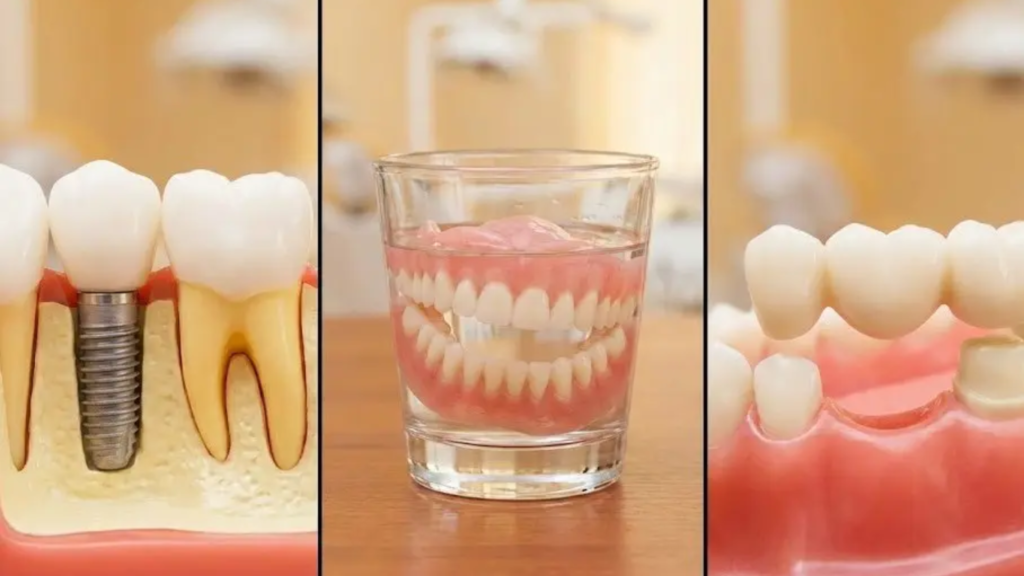
If you’ve lost a tooth or several teeth, modern dentistry gives you three real choices: a dental implant, a fixed bridge, or a removable denture. Every dentist will recommend one of these. Not every dentist will tell you which one is actually best for your specific situation.
This guide is an honest comparison from Dr. Rushabh Doshi, DMD, a fellowship-trained implant specialist who has placed 5,000+ implants and routinely talks patients out of treatments they don’t need. The goal here isn’t to sell you implants. It’s to give you the information to decide which of the three is genuinely right for your case.
The Honest Summary in One Table
| Dental Implant | Dental Bridge | Denture (Partial or Full) | |
|---|---|---|---|
| Cost per tooth (2026) | $4,000–$6,500 | $2,500–$5,000 | $300–$800 (partial); $1,500–$3,500 (full) |
| Lifespan | 20+ years (often lifetime) | 10–15 years | 5–10 years |
| Bone preservation | Yes – stimulates bone | Partial (only above the bridge) | No |
| Affects adjacent teeth | No | Yes – grinds down neighbors | Partial (clasps grip teeth) |
| Removable? | No | No | Yes |
| Feels like a real tooth? | Yes | Mostly | No |
| Maintenance | Brush + floss | Special floss threader | Removal + soaking nightly |
| Surgery required? | Yes | No | No |
| Time to complete | 3–6 months | 2–3 weeks | 4–8 weeks |
| Eat normally? | Yes | Yes | Limited |
| Insurance coverage | Rarely | Often partial | Often partial |
| Best for | Long-term, healthy bone | Healthy neighbor teeth | Multiple missing teeth, tight budget |
Option 1: Dental Implants
A dental implant is a small titanium post surgically placed into the jawbone where a tooth root used to be. After the bone heals around the post (3–6 months, a process called osseointegration), a custom crown is attached on top. The result is a replacement tooth that is anchored independently, looks like a real tooth, and is brushed like a real tooth.
What Implants Do Uniquely Well
They preserve the jawbone. This is the single biggest medical advantage. When a tooth is lost, the bone underneath begins to shrink, typically 25% in the first year alone. An implant stimulates the bone the same way a natural root does, halting the loss.
They don’t affect neighboring teeth. A bridge requires the dentist to grind down the two teeth adjacent to the gap so they can serve as crowned anchors. An implant is independent – it doesn’t touch healthy teeth.
They function like real teeth. Full bite force returns. You can eat steak, apples, and corn on the cob without modification.
They typically last decades. A properly placed implant with good hygiene routinely lasts 20+ years and often a lifetime. The crown on top may need replacement after 15–20 years (~$1,500–$2,500), but the implant itself remains.
Where Implants Are Honestly Not the Right Choice
- If you can’t undergo minor surgery. Uncontrolled diabetes, certain cancer treatments, smokers who won’t quit during healing, and patients on IV bisphosphonates may not be safe candidates.
- If you have severe, untreated gum disease. Active periodontitis must be resolved first. In some cases, the underlying gum health makes implant success unlikely.
- If you have severe bone loss with no graft option. Most patients can have implants placed with grafting, but a small minority cannot.
- If your budget genuinely can’t stretch. A single implant ($4,000–$6,500) financed at $299/mo means roughly 18 months of payments per tooth. If you’re missing 6+ teeth and a bridge isn’t viable, the math may tip toward a partial denture.
Cost Reality
At SmileOn in 2026:
- Single implant + abutment + zirconia crown: $4,000–$6,500, depending on case complexity
- All-on-4 (full arch, fixed): $24,000 per arch
- Snap-on implant denture (4 implants + removable overdenture): $9,000 per arch
Insurance typically covers 0–20% of implant procedures. HSA/FSA funds can be applied. Flexible financing is available at all three of our DFW locations – Arlington Dental Lounge, 360 Dental Lounge in Mansfield, and Irving Family Dental in Irving.
Option 2: Dental Bridges
A dental bridge replaces a missing tooth (or two) by attaching a false tooth to crowns that fit over the two adjacent natural teeth. The dentist grinds down the neighboring teeth, takes impressions, and the lab fabricates a fused unit – two crowns plus the bridge tooth between them – which gets cemented in place.
What Bridges Do Well
No surgery. Just two visits, typically completed in 2–3 weeks. For patients who can’t or don’t want to undergo surgery, this is the main argument.
Lower upfront cost than implants. A three-unit bridge runs $2,500–$5,000, depending on materials and location.
Faster. You walk in with a missing tooth and walk out 2 weeks later with a fixed replacement.
Insurance usually helps. Most dental insurance covers 50% of bridge work after the deductible, which can make the out-of-pocket cost dramatically lower than an implant, at least short-term. Our teams at Arlington Dental Lounge, 360 Dental Lounge, and Irving Family Dental can each verify your specific coverage before your appointment.
The Hidden Costs of Bridges
This is the part most patients don’t get told clearly:
You permanently damage two healthy teeth. The dentist removes enamel from the two anchor teeth so the crowns can fit. Those teeth now have a much higher rate of decay and may eventually need root canals (10–20% chance over a decade). When that happens, you’ve now compromised three teeth instead of one.
The bone underneath the missing tooth continues to resorb. The bridge tooth sits above the bone, not in it. Bone loss continues at the original rate. Over 10–15 years, this often creates a visible gap between the bridge and the gum line.
Lifespan is shorter than that of implants. The average bridge lifespan is 10–15 years. When it fails, and it will, the anchor teeth often need new crowns, and sometimes the entire structure needs to be replaced. The lifetime cost for a single missing tooth, comparing a bridge vs. an implant over 30 years:
- Bridge route: $3,500 initial + ~$4,000 replacement at year 12 + possible root canals on anchor teeth ($1,500–$3,000) = $9,000–$10,500
- Implant route: $5,500 initial + ~$2,000 crown replacement at year 18 = $7,500
They’re harder to clean. Bridges require a special floss threader and consistent technique to avoid decay underneath. Many patients don’t keep up. Our preventive dentistry teams across all three locations can walk you through proper bridge maintenance during your routine cleaning.
When Bridges Are Genuinely the Right Choice
- The two neighboring teeth already have large fillings or crowns (so further preparation isn’t a fresh insult)
- The patient can’t or won’t undergo implant surgery
- Insurance coverage makes the upfront difference substantial, and the patient’s horizon is shorter
- A single tooth gap where the patient wants the fastest fix
Option 3: Dentures
Dentures are removable prosthetics that replace multiple missing teeth, either some of them (partial denture) or all of them (full denture). They sit on top of the gums and are held in place by suction, jaw shape, clasps onto remaining teeth, or adhesive.
What Dentures Do Well
They’re the most affordable option per tooth replaced. A full denture covers all 14 teeth in an arch for $1,500–$3,500. A partial denture (replacing several teeth) runs $300–$800 at the basic end, $1,500–$3,000 for a premium cast-frame version.
No surgery, no preparation of healthy teeth. Easiest from a procedural standpoint.
Insurance usually covers a meaningful portion. Dental insurance typically pays 50% on dentures after the deductible.
Fast. 4–8 weeks from impressions to delivery.
A reasonable solution for older patients with shorter health horizons. If you’re 82 and primarily want to be able to eat and smile for the years you have ahead, a denture is a perfectly respectable choice. Our restorative dentistry teams across all three DFW locations are experienced in fitting high-quality, comfortable dentures for patients at every stage of life.
Where Dentures Genuinely Fall Short
Eating is significantly impacted. Chewing efficiency drops to about 20% of natural teeth. Tough or crunchy foods become difficult or impossible.
Bone loss is fastest with dentures. Because they sit on the gums, the underlying bone shrinks 25% in the first year alone, then continues for life. Within 10–15 years, this changes the shape of the face (collapsed lower face, sunken cheeks).
They move. Even well-fitted dentures shift during eating and speech. The lower denture is particularly notorious. Adhesive paste helps but doesn’t eliminate the problem.
Maintenance is a daily ritual. Removal at bedtime, overnight soaking, and adhesive application in the morning.
They need to be remade every 5–10 years and relined every 1–2 years to accommodate the ongoing bone loss.
When Dentures Are Genuinely the Right Choice
- Many missing teeth and a budget are the dominant constraints
- The patient can’t safely undergo surgery
- Older patient with a shorter health horizon
- The patient strongly prefers the option of removing teeth at night
- As a transitional/healing prosthesis while waiting for definitive implant treatment – a path our implant and prosthetic dentistry teams manage routinely across all three locations
The Decision Framework
If you’re missing one tooth and:
- Have healthy bones and gums → a dental implant is almost always the best long-term choice
- The neighbor teeth already have crowns or large fillings → bridge becomes competitive
- Can’t undergo surgery → bridge is the next best option
If you’re missing 2–4 teeth in a row and:
- Have healthy bone → implants (one per tooth, or 2 implants supporting a 3–4 tooth bridge for cost efficiency)
- Bone is good, but budget is the constraint → implant-supported bridge (uses 2 implants to support 3–4 teeth, lower cost per tooth). Our Irving Family Dental team handles implant-supported bridges routinely.
- Can’t undergo surgery → bridge or partial denture
If you’re missing most or all teeth in an arch:
- Want fixed, eat-anything teeth and bone preservation → All-on-4 ($24,000/arch)
- Want fixed teeth but at a lower cost → snap-on implant denture ($9,000/arch, 4 implants + removable overdenture)
- Need lowest cost or can’t undergo surgery → traditional full denture ($1,500–$3,500/arch)
If you’re missing teeth in both arches, each arch is decided independently. It’s common to have, for instance, All-on-4 on the upper and individual implants or a bridge on the lower.
A Note on the “Twenty-Year Math”
A common pattern in dental decisions is choosing the cheaper option upfront and ending up spending more over time. The 20-year cost comparison for replacing a single missing tooth, including all maintenance and replacements:
- Implant route: ~$5,500 initial + 1 crown replacement = ~$7,000–$8,000 total
- Bridge route: ~$3,500 initial + 1 full replacement + likely root canal on anchor tooth = ~$8,000–$11,000 total
- Partial denture route: ~$800 initial + 3 replacements + adhesives + bone loss effects = ~$3,500–$5,000 total cash, but with significantly compromised function
The implant doesn’t always win on raw dollars, but it almost always wins on dollars-per-year-of-comfortable-function. That’s a different math than what’s on the price tag.
What Honest Providers Will Tell You
A good implant specialist will recommend against implants when they aren’t the right fit. Here are the situations where Dr. Doshi will tell you to consider a bridge or denture instead:
- Your remaining health horizon is short, and the surgical investment doesn’t compound
- You have medical contraindications that make implant success unlikely
- Your budget genuinely can’t accommodate the investment, even financed
- You have anatomical constraints that would make the procedure significantly riskier than alternatives
- The tooth you’re considering replacing has neighbors that already need crowns – a bridge becomes a smart consolidation
If a provider recommends implants for every patient who walks in, that’s a signal to get a second opinion. The right answer is genuinely different for different patients. You can meet the team at any of our three DFW locations to understand the philosophy behind Dr. Doshi’s recommendations.
Frequently Asked Questions
Is it true that implants last forever? The implant itself – the titanium post in the bone – typically lasts a lifetime in the 95%+ of cases that don’t fail. The crown on top of the implant lasts 15–20 years and may need replacement once or twice during your life. “Forever” is overstated; “longest lifespan of the three options” is accurate.
Can I have implants if I have gum disease? Active gum disease must be treated first. After treatment, many patients become excellent implant candidates. The same hygiene that lets you keep your remaining teeth keeps implants healthy. Our general dentistry teams at all three locations provide gum disease treatment in-house before transitioning patients to implant care.
Do bridges damage the teeth they connect to? Yes, the two anchor teeth need to be ground down to accept the crowns. This is permanent. About 10–20% of those teeth eventually require root canals from the trauma of the preparation. This is one of the strongest arguments for choosing an implant over a bridge when both are clinically viable. Our endodontics team handles root canal treatment in-house if it’s ever needed.
Will my insurance cover any of these? Most dental insurance pays 50% on bridges and dentures after the deductible, up to your annual maximum (typically $1,000–$2,000). Most plans cover 0–20% of implants. HSA and FSA funds can be used for all three. The teams at Arlington Dental Lounge, 360 Dental Lounge, and Irving Family Dental can each verify your specific plan before your appointment.
Can I switch later? You can usually upgrade from denture to bridge to implant, but the bone loss that occurs between the original treatment and the upgrade often requires bone grafting first, adding $3,000–$10,000 to the cost. Our oral surgery team performs bone grafting in-house. If you think implants may be your eventual destination, going there sooner is almost always cheaper.
What’s the success rate of each? Implants: 95–97% success at 10 years (Dr. Doshi’s documented rate is 97%). Bridges: roughly 70% still functional at 10 years; 50% at 15 years. Dentures: Well-fitted dentures function for 5–10 years before a remake is needed; the original “success” depends entirely on the fit and the patient’s bone preservation.
How do I know which one is right for me? A clinical exam with imaging is the only honest way to know. The consultation includes a 3D cone-beam CT scan that measures actual bone volume, identifies any anatomical limitations, and lets the dentist give you specific recommendations and pricing for your case. Schedule at the location most convenient for you: Arlington, Mansfield, or Irving.
The Decision in One Paragraph
Dental implants are usually the best long-term answer when you have the bone, the health, and the budget for them. Bridges are a faster, surgery-free option that works well when neighboring teeth already need crowns, and you accept the trade-off of compromising those teeth permanently. Dentures are the most affordable and least invasive option, but with a significantly different daily experience. There is no universally correct answer, only the answer that’s right for your case, based on what’s in your mouth, your medical history, and your priorities.
Schedule Your Consultation
Dr. Rushabh Doshi at SmileOn Dental Implants offers complimentary tooth-replacement consultations across our three DFW.
The consultation includes a 3D scan, comparison of your viable options, and specific cost quotes – no obligation, no pressure.
Call (682) 563-5663 or schedule online at the location nearest you.
Consultation is complimentary for new patients. Treatment plan recommendations require diagnostic evaluation, including imaging. Not applicable to patients with active, untreated periodontal disease. Cannot be combined with insurance. Subject to clinical eligibility.