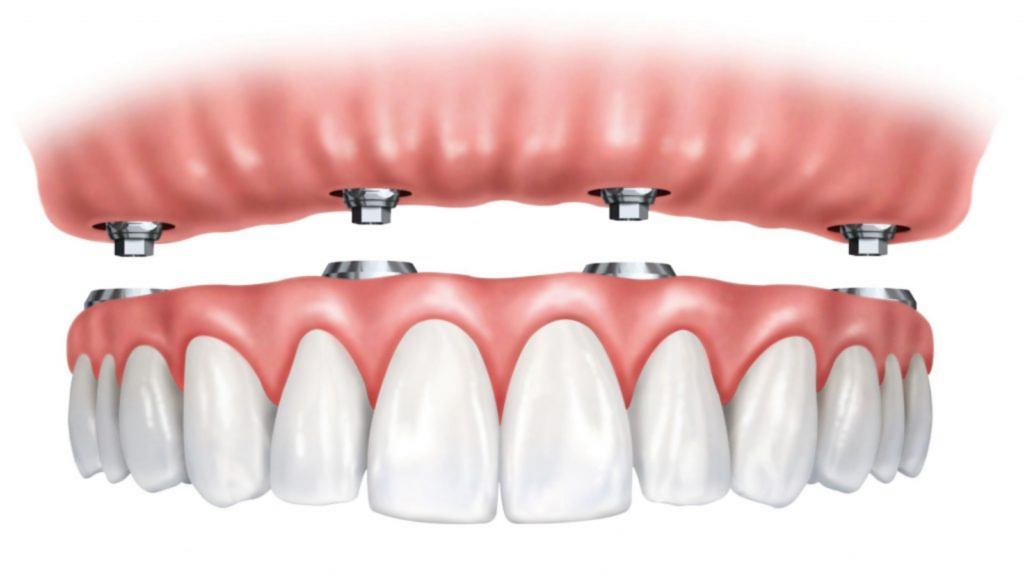
All-on-X is a dental procedure that replaces an entire arch of teeth – upper, lower, or both – using just four strategically placed implants to support a permanent, fixed bridge. You walk into the office with failing or missing teeth and walk out the same day with a completely new set of teeth screwed into your jaw.
If you’ve been wearing dentures and hating them, or if you’re facing the prospect of losing all your teeth in one arch, All-on-X is probably the procedure you’ve been researching without knowing its name.
This guide covers everything from scratch – how it works, who it’s for, what it costs, what the surgery is actually like, and how it compares to the alternatives. Written by Dr. Rushabh Doshi, who performs 100+ full-arch cases per year at SmileOn Dental Implants across three DFW locations.
How All-on-X works – the simple version
Imagine replacing all 10–14 teeth in one jaw with a single, beautifully designed bridge that’s permanently attached to four titanium implants embedded in your jawbone.
That’s All-on-X.
The “all” refers to all your teeth in one arch. The “4” refers to four implants that anchor the bridge. Together, they create a full set of fixed, non-removable teeth that look, feel, and function like the ones you were born with.
The engineering behind four implants
You might wonder: how can four implants support 10–14 teeth? Wouldn’t you need one implant per tooth?
No – and here’s why. The four implants are placed in specific positions and at specific angles that maximize bone contact and force distribution:
- Two front implants are placed straight (vertical) in the front of the jaw, where bone is thickest and most dense
- Two back implants are tilted at a 30–45° angle, following the natural contour of the jaw to engage the longest possible stretch of bone while avoiding the sinus (upper jaw) and nerve canal (lower jaw)
These four implants are then connected by a rigid bridge – a single piece that spans the entire arch. The bridge distributes chewing forces across all four implants simultaneously. No single implant bears the full load. The system works like a well-designed four-legged table: stable, balanced, and strong enough for anything you’d normally put on it.
Why the angled implants matter
The angled posterior implants are what make All-on-X revolutionary. Before this technique, full-arch implant treatment required 6–8 straight implants, extensive bone grafting (6–12 months of healing before implants could be placed), and a much longer, more expensive process.
The angulation achieves three things:
- Reaches bone that straight implants can’t. The front of the jaw retains bone better than the back – even after years of denture wear. Angling the back implants forward lets them engage this denser bone.
- Avoids the sinus and nerve. Straight implants in the posterior jaw often hit the sinus (top) or nerve (bottom). Angulation sidesteps both.
- Eliminates or reduces the need for bone grafting. Because the implants go where bone already exists, most patients don’t need grafts – saving months of healing and thousands of dollars.
Who All-on-X is for
All-on-X is designed for three groups of patients:
1. Current denture wearers
If you’re wearing a full denture and you’re frustrated with slipping, adhesive, limited eating, or the way your face looks, All-on-X replaces your denture with permanent, fixed teeth. No more removal. No more adhesive. No more soft-food-only diet.
About 90% of denture wearers qualify for All-on-X – even after years of bone loss from wearing dentures. The angled-implant design was specifically created for patients with reduced posterior bone.
2. Patients facing full-arch extractions
If your remaining teeth are failing – severely decayed, infected, fractured, or loosened by advanced gum disease – and your dentist has recommended extracting most or all of them, All-on-X lets you go from failing teeth to a complete fixed set in a single surgical day. No months of being toothless between extractions and final restoration.
3. Patients with multiple failing dental restorations
Some patients have a mouth full of crowns, bridges, root canals, and repeated repairs that are increasingly failing. At some point, the cost and complexity of continuing to repair individual teeth exceeds the cost of replacing the entire arch with All-on-X. This is the “reset” option – a clean start with a single, unified restoration.
What the procedure actually involves
Before the surgery
- Consultation + 3D scan (45–60 min) – Dr. Doshi examines your mouth, takes a 3D cone-beam CT scan of your jaw, and determines whether you’re a candidate. You get a treatment plan, cost quote, and financing pre-qualification. This visit is free.
- Pre-surgical planning – your 3D scan is used to map the exact positions for each implant. A surgical guide may be 3D-printed for precision. The lab begins fabricating your temporary bridge based on pre-surgical impressions and your input on tooth shape, size, and color.
The surgical day
This is the day everything happens. Total time at the office: 5–7 hours.
- IV sedation begins. You’re deeply relaxed and won’t remember the procedure.
- Any remaining teeth are extracted. If you still have failing teeth, they’re removed first.
- The jaw is prepared. Bone is smoothed and shaped to receive the implants.
- Four implants are placed per arch – two straight in the front, two angled in the back.
- Abutments are attached to the implants – the connectors that the bridge screws onto.
- The temporary bridge is fitted and attached. Custom-made from pre-surgical impressions, adjusted for bite and appearance, then screwed into the abutments.
- You recover from sedation and receive post-op instructions.
- You go home with a full set of teeth. They’re fixed in place, not removable. You can smile, talk, and eat (soft foods) from day one.
After the surgery
- Days 1–3: Significant swelling and moderate discomfort. Prescription pain medication. Liquid and soft foods. Rest.
- Days 4–7: Swelling declining. Discomfort manageable with over-the-counter medication. Most patients are ready for non-physical work by day 5–7.
- Weeks 2–8: Soft-to-medium food diet as the implants heal. Follow-up visits at weeks 1, 4, and 8.
- Months 3–6: The implants fully integrate with the bone (osseointegration). The final permanent bridge is fabricated.
- Final visit: The temporary bridge is unscrewed and replaced with the permanent zirconia bridge. Bite is checked, adjusted, and finalized. This is your lifetime restoration.
Full pain and recovery guide →
What All-on-X teeth are made of
The bridge – the visible teeth – comes in two main materials:
Zirconia (the standard at SmileOn)
Milled from a solid block of zirconia ceramic. Extremely hard, stain-resistant, color-stable, and natural-looking. Zirconia bridges typically last 15–25 years. This is what the $24,000 price reflects.
Acrylic-over-titanium
A metal-reinforced bar with acrylic teeth bonded to it. Less expensive to fabricate, lighter in weight, but less durable (7–12 years before replacement or significant repair). More prone to chipping, staining, and wear. This is the material typically used in the $13,000–$15,000 All-on-X quotes you see advertised.
The difference matters. When comparing prices across providers, always ask: “Is the final bridge zirconia or acrylic?” The answer explains most of the price gap.
What All-on-X costs
At SmileOn Dental Implants in 2026:
| Per arch | Both arches | |
| All-on-X with permanent zirconia bridge | $24,000 | $48,000 |
| Snap-on implant denture (alternative) | $9,000 | $18,000 |
The $24,000 includes: four implants, abutments, the temporary bridge, and the final permanent zirconia bridge. Extractions ($200–$500/tooth) and IV sedation ($400–$800) are typically additional.
Financing: $0 down, from $299/month through CareCredit, Cherry, Sunbit, or LendingClub. 5-minute approval at the consultation.
Insurance: typically covers 0–20% of implant procedures. HSA/FSA funds can be applied.
How All-on-X compares to alternatives
All-on-X vs traditional dentures
| All-on-X | Traditional denture | |
| Fixed or removable | Fixed (permanent) | Removable (daily) |
| Bite force | ~90% of natural | ~20% of natural |
| Adhesive needed | Never | Often |
| Bone preservation | Yes | No (accelerates loss) |
| Palate covered | No | Upper: yes |
| Lifespan | 20+ years (implants) | 5–10 years |
| Cost per arch | $24,000 | $1,500–$3,500 |
All-on-X costs more upfront. Over 20 years, the total cost difference narrows significantly when you account for denture replacements, relines, adhesives, and the potential bone-grafting cost if you switch to implants later. The daily experience – eating, speaking, confidence – is not comparable.
All-on-X vs implant-supported denture (snap-on)
The snap-on denture ($9,000/arch) is the middle option: 4 implants supporting a removable denture that clicks on and off. It’s dramatically better than a regular denture – no adhesive, better stability, improved eating – but it’s still removable, still covers some palate area, and restores less bite force (~50–60% vs ~90% for fixed All-on-X).
If All-on-X’s $24,000 is beyond your current budget, the snap-on is a strong intermediate step – and the same 4 implants can often be upgraded to a fixed All-on-X bridge later.
All-on-X vs All-on-6
Same procedure, but with six implants instead of four. All-on-6 is indicated for patients with larger jaw arches, heavy grinding, or specific upper-jaw bone patterns where additional support points improve long-term outcomes. For about 70–80% of patients, four implants are clinically sufficient. Dr. Doshi determines which is right based on your 3D scan.
What daily life looks like with All-on-X
This is the section most patients are really looking for – not the clinical details, but what Tuesday feels like.
Morning
Wake up. Brush your teeth (they’re in your mouth, permanently). Use a water flosser for 30 seconds under the bridge. Done. No adhesive application, no alignment check, no soaking solution.
Eating
Breakfast: whatever you want. Eggs, toast, fruit, yogurt, bacon, a breakfast burrito. No restrictions. Lunch: sandwich, salad, soup. Whatever you’d eat with natural teeth. Dinner: steak, grilled chicken, pasta, corn on the cob. The menu is yours again.
The only long-term eating guideline: don’t use your teeth to open packages, don’t chew ice habitually, and avoid extremely hard candy or nuts that could crack the bridge (just as they could crack a natural tooth).
Speaking
No difference from natural teeth. The bridge doesn’t cover the palate, doesn’t shift, and doesn’t click. Speech is normal from the first week, after a brief adjustment to the new bite.
Social situations
Nobody can tell. The bridge is custom-designed to look like natural teeth. You eat at restaurants without worry, speak in meetings without self-consciousness, and smile in photos without thinking about it.
Maintenance
Professional cleaning every 6 months. Annual check on the bridge and implants. Otherwise: brush and water-flosser, the same as with natural teeth.
The emotions nobody talks about
Getting All-on-X is a clinical procedure, but the experience is deeply emotional for most patients. A few things Dr. Doshi hears consistently in post-operative visits:
- “I forgot what eating a steak felt like.” – after years of dentures
- “My grandkids didn’t recognize my smile.” – in the best possible way
- “I stopped making excuses to skip dinner invitations.”
- “I wish I’d done this five years ago.” – the single most common post-op statement
The decision to invest $24,000 in your teeth is significant. The return most patients describe isn’t just dental – it’s a reclaiming of social confidence, dietary freedom, and facial appearance that had been eroding for years.
Frequently asked questions
Is All-on-X the same as “Teeth in a Day”?
Yes – “Teeth in a Day” is a marketing term for the same procedure. You receive a temporary fixed bridge on the same day as your surgery. The final permanent bridge is placed 3–6 months later.
Can All-on-X fail?
Individual implant failure occurs in about 3% of cases. If one of four implants fails, it’s typically replaced while the remaining three support the bridge temporarily. Complete All-on-X failure (all four implants failing) is extremely rare – under 1%.
How soon after All-on-X can I travel?
Most patients are comfortable traveling by car after 3–5 days and by air after 7–10 days. Schedule your first follow-up visit (7–10 days post-surgery) before booking travel.
Can I do one arch now and the other later?
Yes. Many patients do the more urgent arch first and schedule the second arch 3–6 months later. The recovery for the second arch is typically easier because you know what to expect.
What if I’m afraid of the surgery?
IV sedation means you won’t be aware of the procedure or remember it afterward. Dental anxiety is the most common reason patients choose IV sedation, and it’s a completely reasonable choice. Tell us at the consultation – we plan the experience around your comfort level. Full comfort guide →
How is All-on-X different from getting individual implants for every tooth?
Individual implants for every tooth in one arch would require 10–14 implants – $40,000–$90,000 and multiple surgeries over 12+ months. All-on-X achieves a similar functional result with four implants, one surgery, and $24,000. The bridge spans the full arch and distributes forces across all four implants, making individual per-tooth implants unnecessary.
Do I need to do anything special before surgery?
Avoid eating or drinking for 8 hours before surgery (required for IV sedation). Arrange a driver. Wear comfortable clothing. Take any medications Dr. Doshi has prescribed the night before. Stock your kitchen with soft foods for the first week. That’s it.
Is All-on-X right for you?
The only way to know for certain is a consultation that includes a 3D scan. Dr. Doshi will examine your bone, your health, your existing dental situation, and your goals – and give you a straight answer: yes, not yet (here’s what needs to happen first), or here’s what I’d recommend instead.
The consultation is complimentary for new patients and takes 45–60 minutes.
Call (682) 563-5663 or schedule online.
Available at three DFW locations: Mansfield (360 Dental Lounge), Arlington (Arlington Dental Lounge), and Irving (Irving Family Dental).
Consultation is complimentary for new patients. Treatment plan recommendations require diagnostic evaluation, including imaging. Not applicable to patients with active untreated periodontal disease. Cannot be combined with insurance. Subject to clinical eligibility.