One of the most common questions patients ask before committing to dental implants is: How long is the recovery? The honest answer is that most people are surprised by how manageable it is, but you deserve the full picture, not just reassurance.
This guide walks you through exactly what to expect after dental implant surgery, day by day and week by week, so you can plan your schedule, stock your kitchen, and heal with confidence. If you’re still learning the basics, start with our guide to what dental implants are.
The Short Answer: How Long Does Dental Implant Recovery Take?
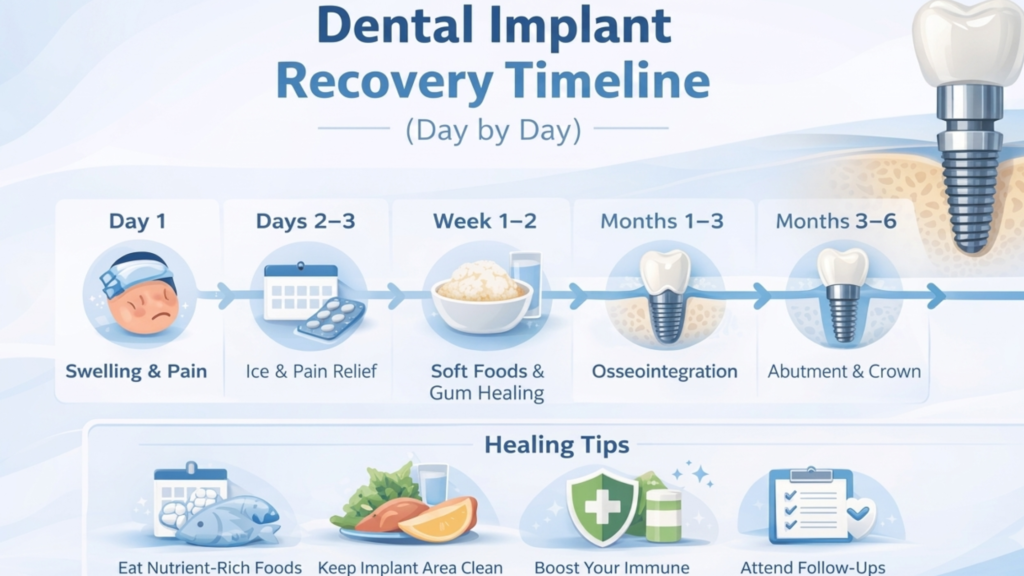
Most patients return to normal daily activities within 2–3 days of surgery. Initial soft-tissue healing (the gums closing over the implant site) takes about 1–2 weeks. Full osseointegration, the process where the implant fuses permanently with your jawbone, takes 3–6 months, though you’ll feel normal long before that’s complete.
The timeline depends on how many implants were placed, whether extractions or bone grafting were involved, and your overall health. Here’s what a typical single-implant recovery looks like.
Day-by-Day Recovery Timeline
Day of Surgery (Day 0)
You’ll leave the office with gauze over the surgical site and detailed aftercare instructions. Numbness from the local anesthetic wears off within 2–4 hours. Some patients feel nothing more than mild pressure; others notice moderate soreness as the numbness fades. (Wondering how comfortable the procedure itself is? See: Do dental implants hurt, and how sedation works.)
What to expect:
- Mild to moderate soreness (manageable with prescribed or over-the-counter pain medication)
- Minor bleeding or oozing, which is normal for the first few hours
- Swelling begins but won’t peak until Day 2–3
- Drowsiness if you received sedation
What to do:
- Apply an ice pack to the outside of your cheek: 20 minutes on, 20 minutes off
- Take your prescribed medication before the numbness wears off completely
- Eat only soft, cool foods (yogurt, smoothies, applesauce, mashed potatoes)
- Rest with your head slightly elevated
- Do not spit, use a straw, or rinse vigorously, as this can dislodge the blood clot
Days 1–3: Peak Swelling & Rest
Swelling peaks around Day 2 or Day 3 and then begins to subside. Bruising may appear on the cheek or jaw, especially after multiple implants or a full-arch procedure. Discomfort is usually at its highest during this window but remains controllable with medication.
What to expect:
- Swelling peaks (this is your body healing, not a sign of a problem)
- Bruising around the jaw or cheek (common, not concerning)
- Discomfort when opening your mouth wide
- Slight difficulty eating anything beyond soft foods
What to do:
- Continue icing for the first 48 hours
- Stick to soft foods at room temperature or cooler
- Take all medications as prescribed (antibiotics and pain relief)
- Avoid physical exertion, bending, or heavy lifting
- Sleep with your head elevated on an extra pillow
Days 4–7: Turning the Corner
By Day 4 or 5, most patients notice a clear improvement. Swelling begins to recede, discomfort drops significantly, and energy returns. Many patients return to desk-based work by Day 3–4 and to more active jobs by Day 5–7.
What to expect:
- Swelling decreasing noticeably each day
- Pain transitioning from needing medication to mild tenderness
- Stitches still present (if non-dissolvable, they’re removed around Day 7–10)
- Appetite returning
What to do:
- Begin gently rinsing with warm salt water (after the first 24 hours)
- Gradually reintroduce warmer, softer solid foods (scrambled eggs, pasta, soft fish)
- Resume light daily activities
- Continue avoiding the surgical side when chewing
- Do not smoke, as smoking significantly impairs healing
Weeks 2–3: Soft Tissue Healing
The gum tissue around the implant site is closing and maturing. Most patients feel essentially normal during this phase. Any remaining soreness is typically mild and intermittent.
What to expect:
- Stitches dissolve or are removed
- Gums appear pink and healthy around the implant site
- No more swelling or bruising
- Eating becomes much more comfortable
What to do:
- Maintain gentle oral hygiene around the site (soft-bristled brush)
- Resume most normal foods, but continue avoiding very hard, crunchy, or sticky items directly on the implant site
- Attend your follow-up appointment so Dr. Doshi can confirm healing is on track
Months 2–6: Osseointegration (Bone Fusion)
This is the phase most people don’t feel at all, but it’s the most important one. The titanium implant is bonding with your jawbone at the cellular level, creating the permanent foundation for your final crown. During this time, the implant is “quiet”: you won’t feel it, and it requires no special maintenance beyond normal oral hygiene.
What to expect:
- No pain or discomfort
- The implant site looks and feels healed
- You may have a temporary tooth or healing cap in place
- Normal eating, speaking, and daily life
What to do:
- Keep up excellent oral hygiene
- Attend scheduled check-ups
- Avoid applying excessive force to the implant (no chewing ice, opening packages with teeth)
- Don’t smoke. This remains the single biggest risk to osseointegration
Final Crown Placement
Once Dr. Doshi confirms osseointegration is complete (typically via imaging), your permanent custom crown is fabricated and placed. This appointment is usually quick, non-surgical, and painless. After it’s seated and adjusted, your implant is fully complete. Curious how your new tooth will hold up over time? Read how long dental implants last.
Full-Arch Recovery: What’s Different?
If you’re receiving All-on-4 or All-on-X full-arch implants, the recovery follows the same general pattern, but there are differences worth knowing:
- You leave with teeth on Day 0. Full-arch patients receive a same-day prosthesis, so there’s no visible gap during healing.
- Swelling and bruising are typically more pronounced because the procedure involves more implants and often extractions.
- A soft-food diet is recommended for 8–12 weeks to protect the implants during osseointegration.
- Follow-up visits are more frequent in the first few months to monitor healing and adjust the prosthesis if needed.
- The final zirconia prosthesis is placed after 4–6 months, once all implants have fully integrated.
Most full-arch patients describe the first 5–7 days as the most challenging, followed by rapid improvement.
Recovery Timeline At a Glance
| Phase | Timeframe | What’s Happening | How You Feel |
|---|---|---|---|
| Day 0 | Surgery day | Implant placed, blood clot forming | Numb → mild/moderate soreness |
| Days 1–3 | Peak healing | Swelling peaks, body’s inflammatory response | Most discomfort (manageable with meds) |
| Days 4–7 | Improvement | Swelling drops, tissue repair accelerates | Much better, returning to activities |
| Weeks 2–3 | Soft tissue healing | Gums close and mature | Feels normal, mild tenderness |
| Months 2–6 | Osseointegration | Implant fuses with jawbone | No symptoms, just waiting |
| Final visit | Crown placement | Permanent tooth seated | Complete: your new tooth is done |
8 Tips to Heal Faster After Dental Implant Surgery
- Follow your aftercare instructions exactly. They exist because they work.
- Ice early and often. The first 48 hours of icing make the biggest difference in swelling.
- Don’t skip medications. Take antibiotics for the full course, even if you feel fine.
- Eat soft, nutrient-rich foods. Protein, vitamins A and C, and zinc all support tissue repair. Smoothies with protein powder, scrambled eggs, and bone broth are excellent choices.
- Do not smoke. Smoking constricts blood vessels and starves the surgical site of oxygen. It is the leading controllable cause of implant failure.
- Sleep elevated. An extra pillow reduces swelling overnight.
- Skip the gym for a week. Elevated heart rate and blood pressure increase bleeding and swelling.
- Keep your follow-up appointments. Early detection of any issue means a simple fix, not a complicated one.
What to Eat After Dental Implant Surgery
Days 1–3 (soft and cool):
- Smoothies and protein shakes (no straw)
- Yogurt, applesauce, pudding
- Mashed potatoes, mashed avocado
- Lukewarm soup (blended, no chunks)
- Ice cream (a legitimate recovery food)
Days 4–14 (soft solids):
- Scrambled eggs, omelets
- Soft pasta, risotto
- Steamed vegetables (well-cooked)
- Soft fish (salmon, tilapia)
- Oatmeal, pancakes
After 2 weeks (gradual return to normal):
- Most foods are fine. Just avoid very hard, crunchy, or chewy items on the implant side until cleared by your dentist
When to Call Your Dentist
Some symptoms are normal. Others are not. Contact SmileOn immediately if you experience:
- Pain that is getting worse after Day 3 (not better)
- Swelling that increases after the first week
- Heavy bleeding that doesn’t stop with pressure
- Fever above 101 °F
- Pus or discharge from the implant site
- Numbness or tingling that hasn’t resolved after 24 hours
- A feeling that the implant is loose
These symptoms are uncommon (Dr. Doshi’s implant success rate is 97%), but catching an issue early is always better than waiting.
Your Recovery Starts With the Right Team
The single biggest factor in a smooth recovery is the skill and experience of your implant dentist. Dr. Rushabh Doshi has placed over 5,000 dental implants with a 97% success rate. SmileOn’s in-house 3D imaging, digital workflow, and same-day lab mean your surgery is planned with precision, and precision leads to faster, easier healing. Not sure what to look for? Here’s how to choose an implant dentist in DFW, and you can see real results in our smile gallery.
Ready to learn what recovery will look like for your specific case?
Book your free consultation or call (682) 563-5663 today. We’ll walk you through every step: before, during, and after.
SmileOn Locations:
- Mansfield: 3550 East Broad Street, Suite 112, Mansfield, TX 76063
- Arlington: 4010 N Collins St #104, Arlington, TX 76005
- Irving: 2932 N. Belt Line Rd., Irving, TX 75062
Frequently Asked Questions
How long does it take to recover from a dental implant? Most patients return to daily activities within 2–3 days. Soft tissue healing takes 1–2 weeks, and full osseointegration (the implant bonding with bone) takes 3–6 months, though you’ll feel normal well before that.
Is dental implant recovery painful? Most patients describe discomfort as less than they expected, comparable to a tooth extraction. Pain peaks on Days 1–3 and is well-managed with over-the-counter or prescribed medication. By Day 5–7, most patients need no pain medication at all. For more detail, see our guide on implant pain and sedation options.
When can I eat normally after a dental implant? Soft foods are recommended for the first 1–2 weeks. Most patients gradually return to a normal diet within 2–3 weeks, avoiding very hard or crunchy foods on the implant side until cleared.
Can I go to work the next day after dental implant surgery? Many patients with desk jobs return to work the day after surgery or within 2 days. Physically demanding jobs may require 4–7 days off. Full-arch procedures typically need a few more days of rest.
What is the fastest way to recover from dental implant surgery? Follow your aftercare instructions, ice for the first 48 hours, avoid smoking, eat nutrient-rich soft foods, sleep elevated, and attend all follow-up appointments. These steps consistently produce the smoothest recoveries.
How long after an implant can I get my permanent crown? Typically 3–6 months after implant placement, once osseointegration is confirmed. During the waiting period, you may have a temporary tooth or healing cap in place.